The artist
Hamed Ouattara
Burkinabè multidisciplinary artist designer, author of SANKARA, L'ÉTERNEL VEILLEUR. He turns salvaged industrial metal into sculptural pieces that carry African memory and identity.
The path
Hamed Ouattara, whose civil name is OUATTARA Mohamed Sékou, is a graduate of the École nationale supérieure de création industrielle in Paris. In 2002 he founded the Studio Hamed Ouattara in Ouagadougou, on the Route du SIAO: a workshop organised as a guild, with some fifteen craftsmen.
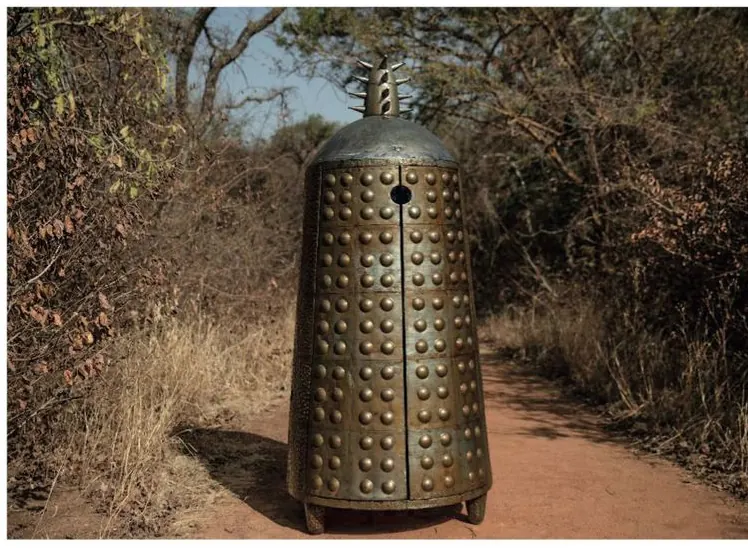
His practice starts from salvaged industrial metal — drums, sheet, the discards of the city — which he deforms, presses and assembles into sculptural pieces. The vocabulary of forms comes from Sudano-Sahelian earthen architecture: the volumes, the setbacks, the thicknesses and the textures come straight from it.
He has been a Chevalier de l'Ordre du mérite des Arts since 2014, won the Africa Design Award in the same year, and is president of the Association Art Contemporain du Burkina Faso.
Permanent collections
- Victoria and Albert Museum, London
- Centre Pompidou, Paris
- Vitra Design Museum, Weil am Rhein
- Brooklyn Museum, New York
- Denver Art Museum, Denver
He is represented exclusively by the Friedman Benda Gallery, in New York.
The workshop
The Studio Hamed Ouattara is a place of production and a place of transmission. The guild is the way of working there: gestures are handed on through practice, and the pieces leave the workshop carried by a collective of craftsmen.
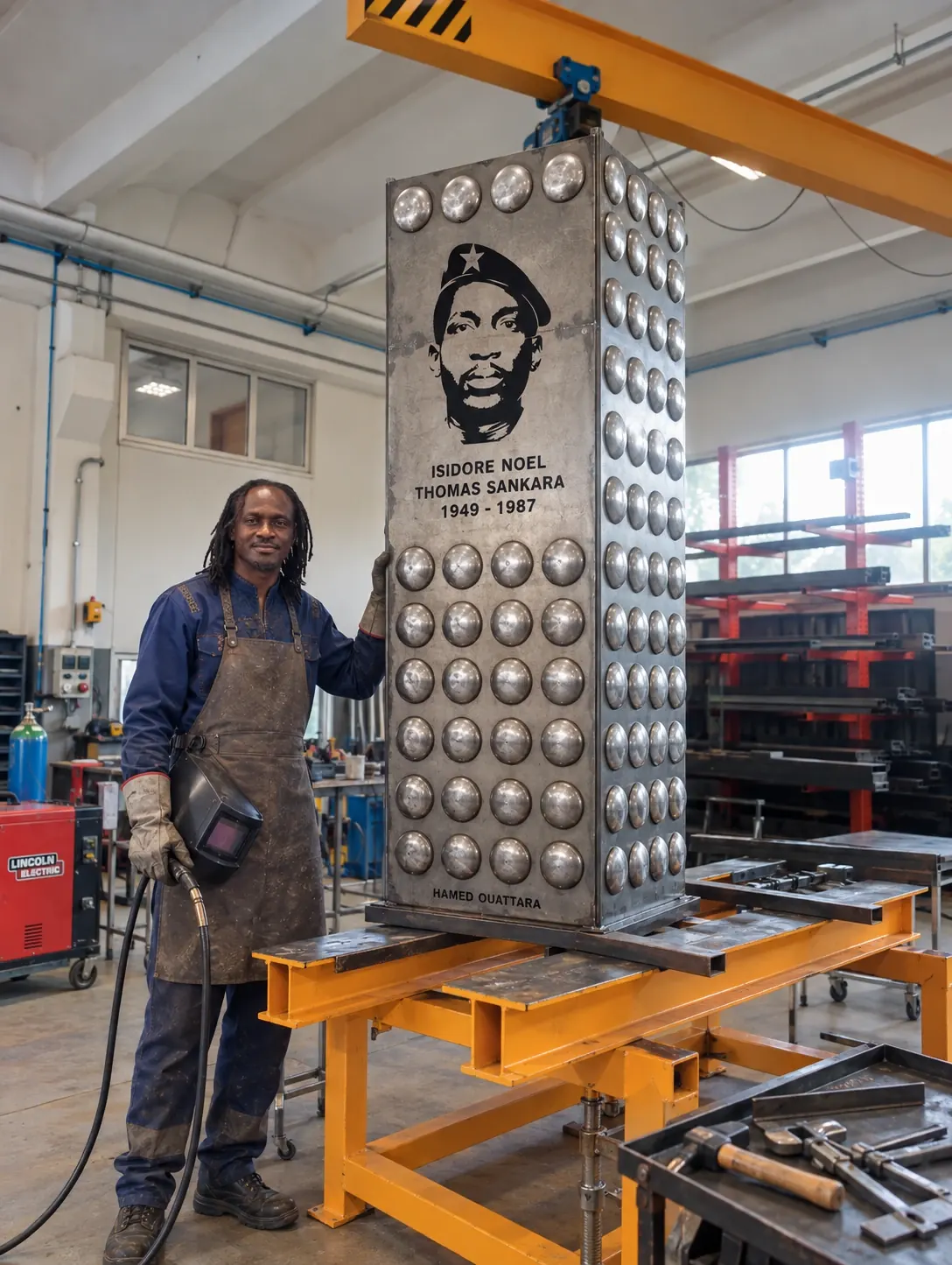
It is in that workshop that the Rome monument was conceived: the sculptural decision, the drawing of the faces, the calculation of the bosses and the vector files for cutting.
The language of the bosses, before the monument
The half-spheres struck into steel were not born with the Rome monument. They have been the language of the workshop for more than twenty years, and they come from the great Sudano-Sahelian earthen architectures: Djenné, Timbuktu, Bobo-Dioulasso.