The story of the project
How the park came to have its work
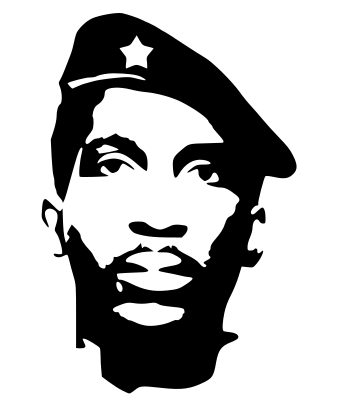
The Parco Thomas Sankara in Rome is the only public space in Europe given over entirely to the memory of the President of Burkina Faso. It was not born of an institutional decision: it was born of one man's persistence.
A Burkinabè initiative
The park was carried by Comrade Madi Sakandé, of the Burkinabè diaspora in Italy. He is the donor of the work, to the benefit of the Burkinabè State, for the Parco Thomas Sankara in Rome.
We have known each other since childhood in Ouagadougou. We grew up in the same city, at the same time, formed by the same words and the same ideal. That is why this project came back to the two of us: one brings the means and the initiative, the other brings the art, the time and the gesture.
The green space was named by the III Municipio of Rome, in the Montesacro district. The commemorative plaque was unveiled on 17 September 2025, in the presence of the Ambassador of Burkina Faso to Italy and of representatives of the City of Rome.
He asked me for a work, not a statue.
The park, in Rome
Via Ugo della Seta, in the III Municipio. The plaque reads “PARCO THOMAS SANKARA (1949 - 1987) — PRESIDENTE DEL BURKINA FASO”.
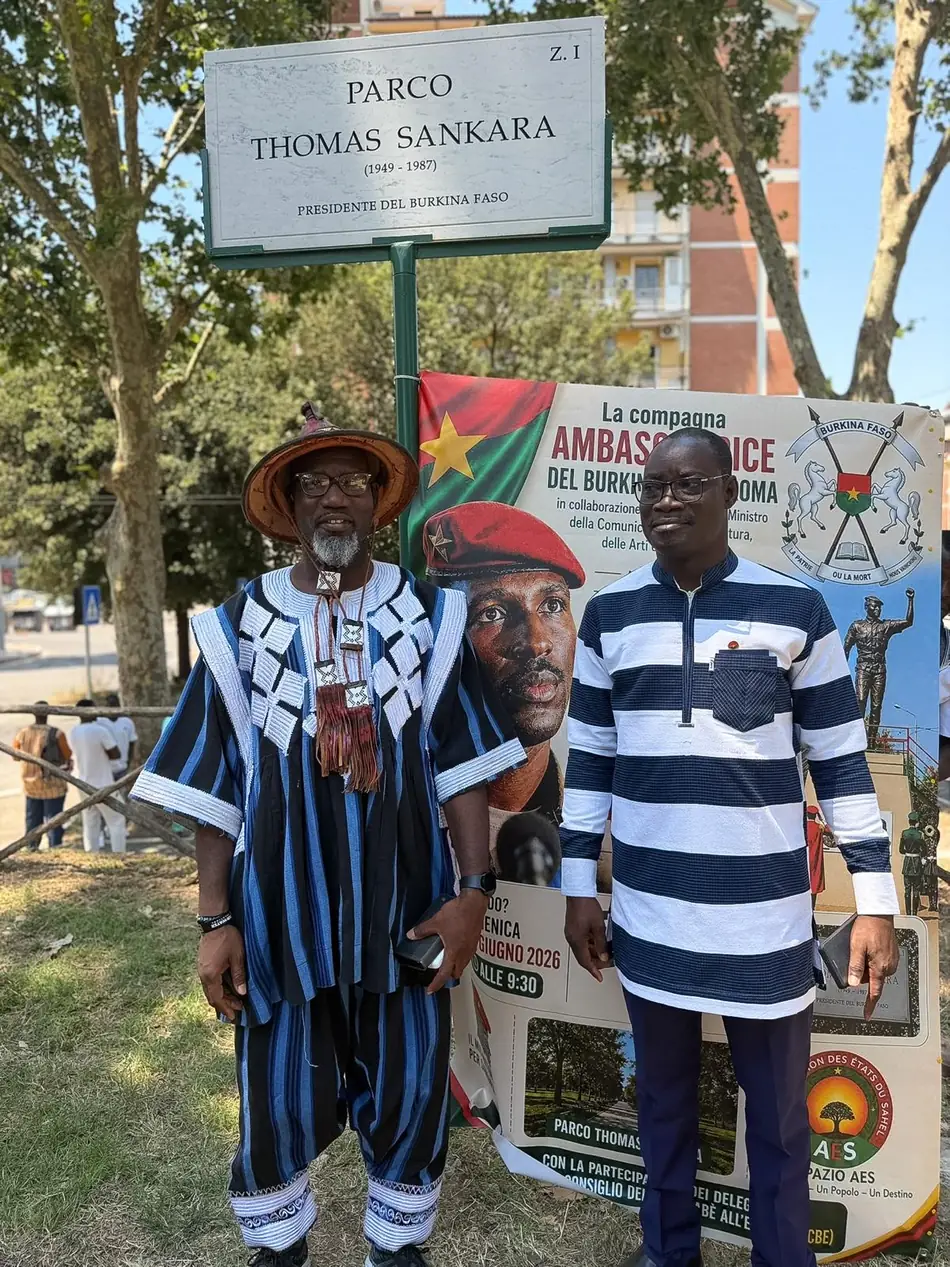
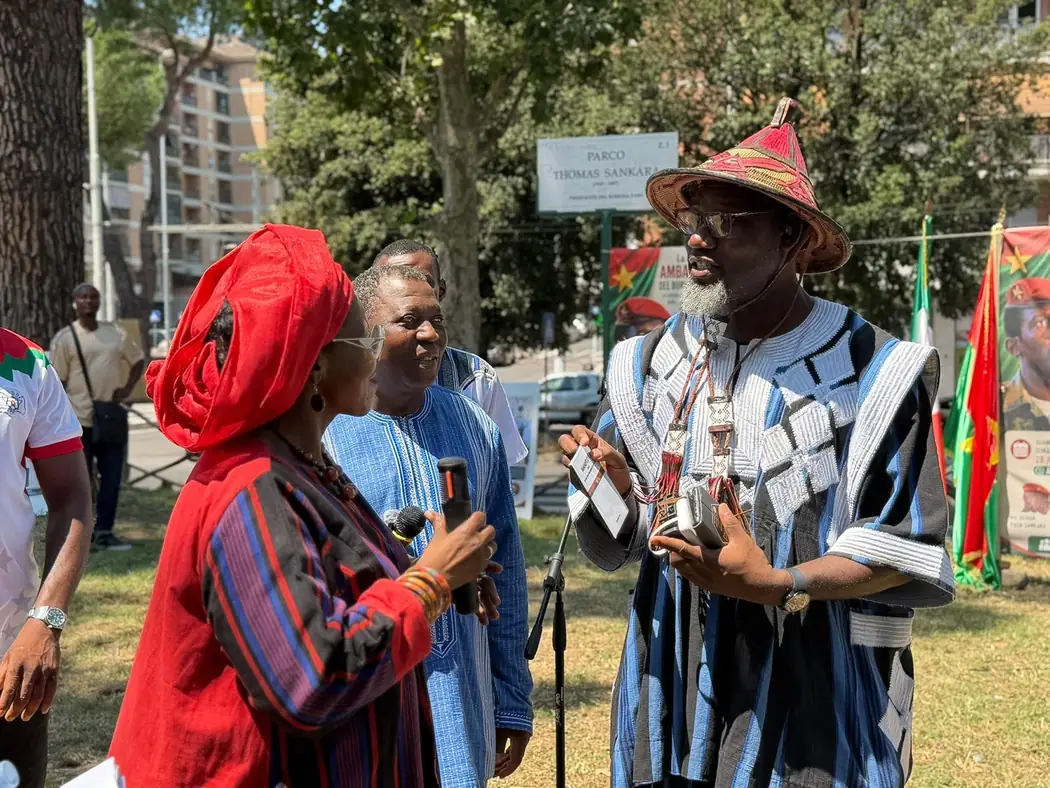
The meeting was organised by the Embassy of Burkina Faso in Rome, in collaboration with the Comrade Minister of Communication, Culture, Arts and Tourism, with the participation of delegates of the Haut Conseil des Burkinabè de l'Étranger.
Why this is not a statue
I set the figurative statue aside for three reasons.
The place. The Parco Thomas Sankara is an urban park people walk through, not a dedicated memorial site where one comes to stand before an effigy. People pass through it, cut across it, stop in it for a moment. A work legible from every angle belongs there better than a statue with a single face and a single way of being read.
The climate. Corten steel withstands the European climate without maintenance. For a work left in the open air in a public park, out of any close supervision, lasting was a starting condition, not an added quality.
The plastic language. The vocabulary used here — salvaged metal, pressed bosses, volumes drawn from Sudano-Sahelian earthen architecture — is the one I have been developing for more than twenty years in my workshop in Ouagadougou. It makes this monument a Burkinabè work in full, and not a commission carried out in a borrowed style.
From Ouagadougou to Bologna
I designed the work in full, from the sculptural decision through to the vector files for cutting. The steel plates were worked in Italy by workshops equipped for laser cutting and for pressing the bosses. The assembly, the welding and the finishing I did myself, in Bologna, before transport and installation in Rome. The monument carries my signature, cut into the steel at the foot of the portrait face, by the same technique as the face.
A monument complementary to the national Memorial
SANKARA, L'ÉTERNEL VEILLEUR is complementary to, and distinct from, the Thomas Sankara Memorial rising in Burkina Faso. It is neither its replica, nor its extension, nor its foreshadowing, and it replaces it in nothing.
The hearth of that memory is in Ouagadougou: it is there that the Memorial is being built, it is there that the Mausoleum of Comrade President Thomas Sankara and of his twelve companions was unveiled. This monument is a Burkinabè artistic contribution carried abroad, which belongs to the national movement for the restoration of memory led by the authorities of Burkina Faso, under the aegis of the Ministry of Communication, Culture, Arts and Tourism (Ministère de la Communication, de la Culture, des Arts et du Tourisme).