Reading the numbers
The twelve companions, and the 4th of August
Nothing in this weave is left to chance. The numbers were sought, then settled, before the first line was drawn: the grid of the work counts those who fell with him, and the day it all began.
What the weave counts
| Element of the monument | What it counts |
|---|---|
| 12 rows on every face | The twelve companions who fell with him |
| 4 columns of bosses | 4 August 1983, the opening of the Democratic and Popular Revolution |
| 2 faces carrying the portrait | The two directions, north and south |
On 15 October 1987, Comrade President Thomas Sankara was assassinated in Ouagadougou with twelve of his companions. They rest today beside him in the Mausoleum, in Ouagadougou. The monument carries twelve rows of bosses, on each of its four faces.
The four columns say 4 August 1983, the day the Democratic and Popular Revolution opened. The sculpture itself has four faces.
And the face looks in two opposite directions, for the one arriving as much as for the one leaving. Those two directions are north and south — Europe and Africa, and the two words the Comrade President used to speak of debt and of the dignity of peoples.
These numbers come out of my research, and I settled them before I drew. A memorial sculpture that counted nothing would be mere ornament: this one had to carry a date and names, and the form was built around them.
The place of the void
The weave is the same on all four faces: forty-eight places, twelve rows of four. The two textured faces carry them all.
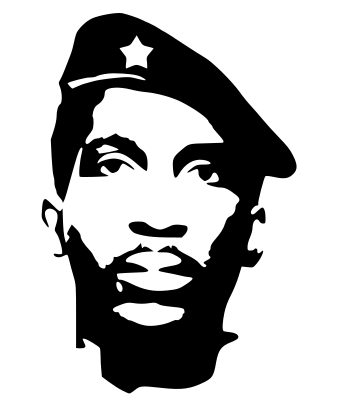
On the two faces that carry the portrait, twenty of those places are given back to the void: sixteen for the face, four for the name block. Twenty-eight remain. Where the metal has not been struck, that is him.
The monument carries one hundred and fifty-two bosses in all.
The drawing of the two faces
Flat elevation, at true dimensions. The portrait faces carry the face, the name and the signature cut clean through the plate; the textured faces carry no cut at all.
A prism 200 cm high, 70 × 70 cm in section, in 6 mm Corten steel. Hemispherical bosses 139 mm across standing 20 to 25 mm proud, the same size on every face, 167 mm apart horizontally and 165 mm vertically. The side bands framing the face are left smooth.
The exact count
| Face | Number | Bosses | Total |
|---|---|---|---|
| Textured face | 2 | 48 per face — 4 columns × 12 rows | 96 |
| Portrait face | 2 | 28 per face — 4 in the top row, 24 in the lower part | 56 |
| The monument as a whole | 4 | — | 152 |
A boss is one blow. The plate has to be struck for it to appear. This regular grid is the count of repeated work, of the gesture begun again, of the collective effort that builds. It is the people around the man: the face is opened in the metal, but it is the struck metal that surrounds and holds it.