
Parco Thomas Sankara — Rome, Italy
SANKARA, L'ÉTERNEL VEILLEUR
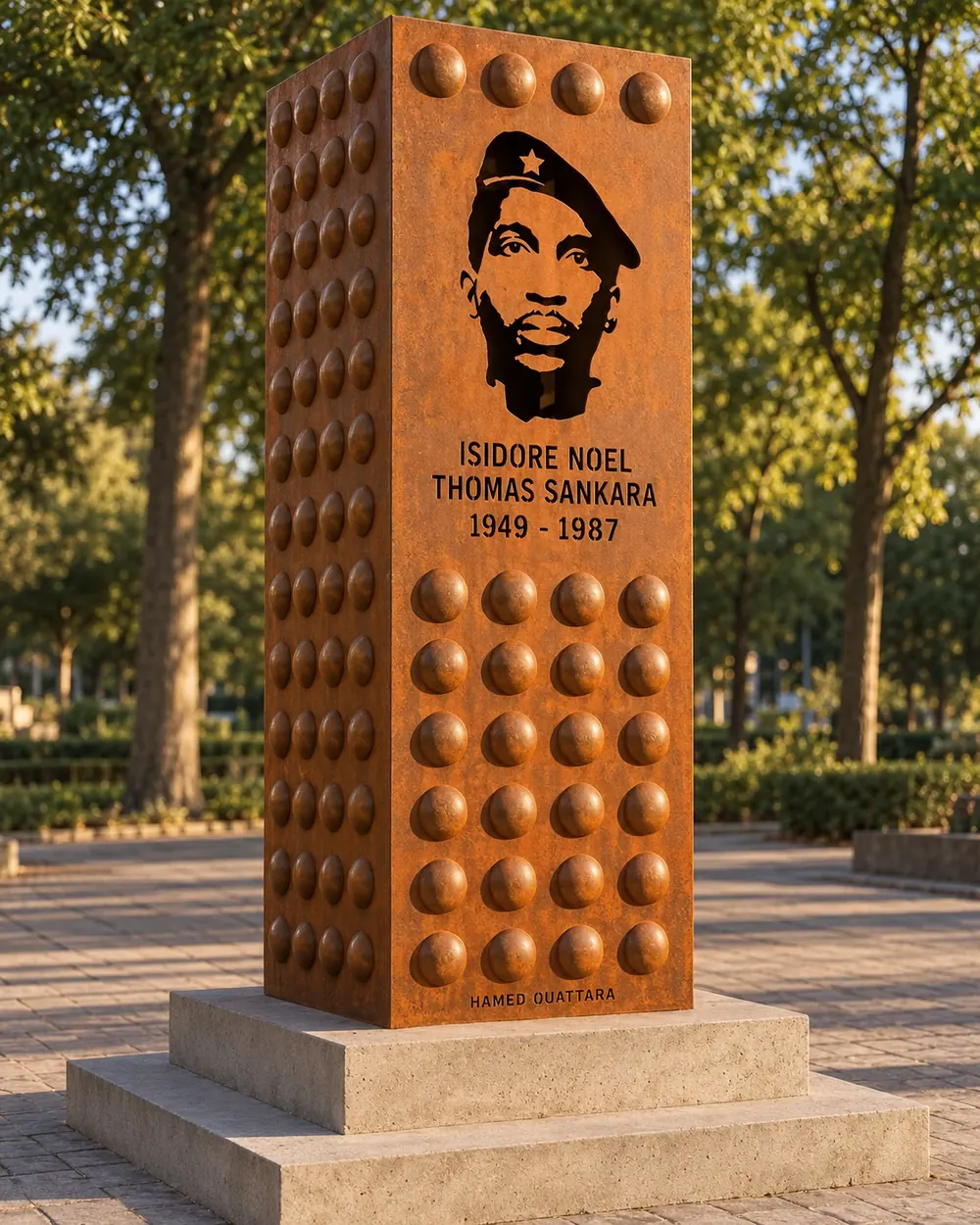
A monumental Corten steel sculpture by the Burkinabè artist Hamed Ouattara, destined for the Parco Thomas Sankara in Rome, the only public space in Europe given over entirely to the memory of Comrade President Thomas Sankara.
Saturday 24 October 2026 The monument stands at the Parco Thomas Sankara, in Rome. Unveiling on Saturday 24 October 2026.
The work in brief
A hollow rectangular prism in six-millimetre Corten steel, two metres high, standing on a stepped reinforced concrete base cast on site. Two opposite faces carry the portrait of Comrade President Thomas Sankara, cut clean through the plate: it is the voids opened in the steel that make the face, the starred beret and the gaze. Through those openings the visitor sees the half-darkness inside the monument.
The two other faces carry no cut at all. They are covered with hemispherical bosses pressed into the steel, which give it a skin and a beat.
The two faces that carry the portrait look north and south: one towards Africa, the other towards Europe. The monument turns its back on neither.
Reading the numbers
On 15 October 1987, Comrade President Thomas Sankara was assassinated with twelve of his companions. The weave of the monument counts them, and counts the day it all began.
rows on every face
The twelve companions who fell with him.
columns of bosses
4 August 1983, the opening of the Democratic and Popular Revolution.
faces carrying the portrait
The two directions, north and south.
A Burkinabè work carried abroad
The monument was conceived and drawn in Ouagadougou, in a plastic vocabulary developed over more than twenty years at the Studio Hamed Ouattara. The steel plates were worked in Italy by workshops equipped for laser cutting and for pressing the bosses, but the assembly, the welding and the finishing were done by the artist himself, in Bologna.
The work is given by Comrade Madi Sakandé, of the Burkinabè diaspora in Italy, to the benefit of the Burkinabè State, for the Parco Thomas Sankara in Rome.
This monument is complementary to, and distinct from, the Thomas Sankara Memorial rising in Burkina Faso. It is neither its replica nor its extension: it carries abroad, into a European public space, a memory whose hearth remains in Ouagadougou.
One gesture among others
This monument belongs to a wider movement: the Thomas Sankara Memorial rising in Ouagadougou on the site of the Conseil de l'Entente, the Mausoleum where the Comrade President rests with his twelve companions, and the worldwide campaign Ma brique pour Sankara — My brick for Sankara, which calls on everyone to bring their own contribution to the building of the Memorial.
A brick is exactly what this work says in its own way: a boss is one blow, and it is the count of the repeated gesture that builds.
Following the project through to the unveiling
The workshop photographs show the work as it was made, from bare steel to oxidised Corten. The project diary follows the stages, from the cutting of the plate to the installation in the park.
After the unveiling, this site will open the virtual tour: a complete photographic rotation around the installed monument, for those who cannot come to Rome.
Come and see the monument The work in pictures Project diary