The work
A hollow prism, two faces, two skins
SANKARA, L'ÉTERNEL VEILLEUR is an upright rectangular prism in Corten steel, hollow, to be raised on a reinforced concrete base cast on site at the Parco Thomas Sankara in Rome.
Specification
| Title | SANKARA, L'ÉTERNEL VEILLEUR |
|---|---|
| Author | Hamed Ouattara, 2026 |
| Form | Upright rectangular prism, hollow |
| Height | 200 cm, base excluded |
| Section | 70 × 70 cm |
| Material | Corten steel, 6 mm thick |
| Portrait | 2 opposite faces, cut clean through, in negative space |
| Texture | Hemispherical bosses, 139 mm across, standing 20 to 25 mm proud |
| Number of bosses | 48 per textured face — 4 columns × 12 rows —, 28 per portrait face, 152 in all |
| Base | Reinforced concrete cast on site, stepped |
| Finish | Bare Corten, left to oxidise freely over time |
| Estimated weight | About 370 kg |
| Siting | Parco Thomas Sankara, Via Ugo della Seta, III Municipio, Rome, Italy |
| Design | Studio Hamed Ouattara, Ouagadougou, Burkina Faso |
| Fabrication | Italy, Bologna area |
The face, opened in the metal
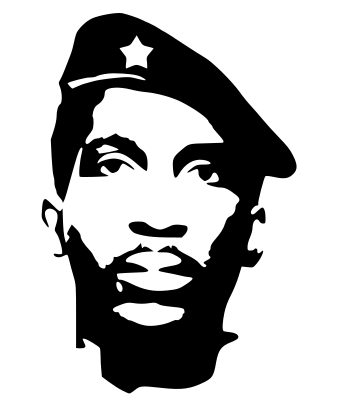
Two opposite faces carry the portrait of Comrade President Thomas Sankara. The military beret with its star, the gaze and the line of the face are rendered faithfully: the likeness chosen is the one the Burkinabè people know and recognise.
What is singular about it is how it is obtained. The face is neither painted nor engraved: it is cut clean through the plate. The dark areas of the portrait are voids straight through the steel, the light areas are the steel left in place, and it is the contrast between metal and daylight that builds the figure, with the sharpness of a great stencil. The side bands framing the face are left smooth, without bosses.
This method gives the portrait a changing presence. In the morning sun it stands out sharply, at noon it quietens, at dusk the half-darkness inside the monument gives it depth. The President is not fixed there in a pose: he is present differently at every hour of the day.
The name block — ISIDORE NOEL THOMAS SANKARA 1949 - 1987 — and the artist's signature, 340 by 40 millimetres at the foot of the face, are cut on the same principle, in bridged stencil letters.
Set on a north-south axis
The two faces that carry the portrait look north and south.
The southern one looks towards Africa: the Sahel, Burkina Faso, the country whose earth the monument already carries, since the colour of Corten steel is the colour of laterite. The northern one faces Europe, the continent that receives it.
This is not only a matter of the compass. North and South are the words Comrade President Thomas Sankara used to speak of debt, of tutelage and of the dignity of peoples. The monument turns its back on neither: it holds both gazes at once, for the one arriving as much as for the one leaving.
Standing on that axis, it becomes a bearing point — for his nation, and for the world.
That axis is part of the work, as much as the cutting of the face. The base will be cast accordingly.
The skin of the metal, the work of the hands
The faces of the monument are covered with bosses, those half-spheres struck into the steel which have been the language of the workshop for more than twenty years. They come from the great Sudano-Sahelian earthen architectures: from Djenné, from Timbuktu, from Bobo-Dioulasso, from those thick bristling walls that breathe under a low light.
But they say something else as well. A boss is one blow. The plate has to be struck for it to appear. This regular grid is the count of repeated work, of the gesture begun again, of the collective effort that builds. It is the people around the man: the face is opened in the metal, but it is the struck metal that surrounds and holds it.
The metal that does not give way
Corten steel has a rare property: it rusts at the surface, and that rust protects it instead of destroying it. It does not decay, it takes on a patina. Exposed to rain, to winters, to decades, it darkens, it settles, it holds. For a work left in the open air in a public park, this guarantees that it will last without any maintenance falling to the local authorities.
No other material says better what there was to say. A just idea is not kept under glass; it stands out in the open, it takes the blows, and it is in taking them that it hardens. The colour of this metal is the colour of laterite, the red earth of Burkina Faso. In Europe, the monument will carry the colour of Burkinabè soil.
How it was made
The steel plates were worked in Italy by workshops equipped for laser cutting and for pressing the bosses. The assembly, the welding and the finishing were done by the artist in person, in Bologna, before transport and installation in Rome.